Is it Worth It? A Cost-Benefit Conversation Around Strategic Deworming
By Amy Barkley, Livestock Specialist, CCE SWNYDLFC Team
Deworming is an essential part of raising sheep and goats, but it is also time-consuming and expensive. And, if you are in the process of working through identifying which dewormers work on your farm, it can be even more expensive as you purchase full bottles of dewormer only to possibly find out they don’t work. With the disadvantages being so great, why even bother with evaluation and strategic deworming? Why not just blanket deworm? This article explores the time and monetary investment to implement an intensive internal integrated pest management program.
Time Investment
The largest investment in an integrated pest management (IPM) program is time. Previous recommendations suggested blanket deworming the whole flock or herd multiple times a year, which is a relatively low time investment involving running all animals through the chute and giving them dewormer. This is no longer the current advice. Instead, the scientific community recommends evaluating animals for deworming on a regular schedule and only treating those who need it. Animals are evaluated every 2-4 weeks from a month prior to lambing/kidding or when pasture access is given - whichever comes first - through the end of the grazing season. This is the time when barber pole worm and brown stomach worm have the greatest impact on a herd or flock.
Consider a flock 25 sheep, which is the typical size of a flock in Southwest NY. For this example, let’s also assume that the target lambing window is in January, and that you’re checking the animals the month leading up to lambing and then monthly following lambing until they go out on pasture in May. This is 6 total checks. The time to perform a 5-Point Check© on check each member of the flock (body condition score, dag score, wool/hair quality, presence/absence of bottle jaw, FAMACHA score, and deworm takes approximately 1.5 hours with two people, for a total of 18 person hours over 6 months.
Once the animals go onto pasture, you’ll be evaluating FAMACHA scores every two weeks, with a full evaluation of the other parts of the 5-Point Check© performed as needed. Bringing the animals to the chute now takes more time, since you have to bring them in from the pasture. At this point in the season, there are now lambs to evaluate too. If you have a lamb crop that meets the national average (106% in 2024), you have 52 animals to evaluate. Let’s say this takes 2 hours for two people since we’re primarily targeting FAMACHA, rather than the whole 5-point check. From June – October, that’s 10 checks, or another 40 person hours.
This gold-standard check process will take approximately 58 person hours annually. If your time is valued at minimum wage, $16/hour, then your total monetary investment for time is $928.
Of course, throughout this process, you are only deworming those animals that need it. Those being animals that score poorly on the FAMACHA test and/or have poor body condition, hair coats, unexplained presence of dags, or presence of bottle jaw. The time estimates above include taking notes for your records to remember which animals were dewormed and what their evaluation values are over the course of the season.
Dewormer Investment
Deworming drugs are expensive, there's no doubt about that. Even the smallest packages will often treat about 100 animals. There is an inclination not to waste dewormer, especially powders, which have a short use life once mixed, so the thought may be to deworm all animals just to use up the drug. However, this increases the rate of resistance among parasites, and complete resistance can develop in as few as 10 years. It behooves us to deworm only the animals that need it to slow resistance by keeping a population of susceptible parasite refugia, keeping tools in our toolbox for years to come.
According to a popular online store for small ruminant products, the average cost of deworming drugs is between $0.25 and $1.00 per dose. Liquid dewormers can be resealed and stored until needed, so a single purchase for a group of 25 animals will usually last 2 years if you deworm only the animals that need it. Powdered dewormers must be purchased anew each time you deworm, but they generally cost closer to $25 per packet ($0.25/dose). These recommendations are a rule of thumb – you’ll need to check the labels for the use by information and adhere to it or you may end up using an ineffective dewormer.
Equipment investment
Across SWNY, farms either purchase a commercial handling system, build one themselves out of lumber, or build a makeshift one from cattle panels. The system that works for you may not work for someone else, though a permanent handling system becomes more valuable if you check animals frequently. Costs vary widely depending on the materials used, the size and design of the raceway, whether the chute includes a scale, and whether you have a series of holding pens, gates, and a crowding pen. Commercial systems range from about $2,500 to $10,000. A much smaller but necessary investment is a drenching syringe, which costs around $25 for a basic model.
Weighing the Benefits
So, considering the time, dewormer, and equipment investments, is it worth pursuing an IPM protocol on your farm? Start with your history of death losses from barber pole worm or brown stomach worm. What was the value of the animals lost, and what is your average loss per year? Next, consider the decrease in meat or milk yield in animals with underlying infections that aren't severe enough to cause death. What is an additional pound of live gain or quart of milk worth to you, and would the investment of regularly evaluating and deworming the flock balance out? While this decision comes down to the individual producer, many find that implementing IPM protocols pays off.
This work is supported by the Northeast Extension Risk Management project award no. 2024-70027-42540, from the U.S. Department of Agriculture's National Institute of Food and Agriculture.
Resources:
1.) American Lamb Board (2025). 2024 Annual Sheep Industry Market Report Now Available. https://lambboard.com/weekly-news/2024-annual-sheep-industry-market-report-now-available
2.) Kotze and Prichard (2016). Chapter Nine – Anthelmintic resistance in Haemonchus contortus: History, Mechanisms, and Diagnosis. Advances in Parasitology. 93, 397-428.
3.) New York State Department of Labor (2026). Your New York State Minimum Wage. https://dol.ny.gov/minimum-wage
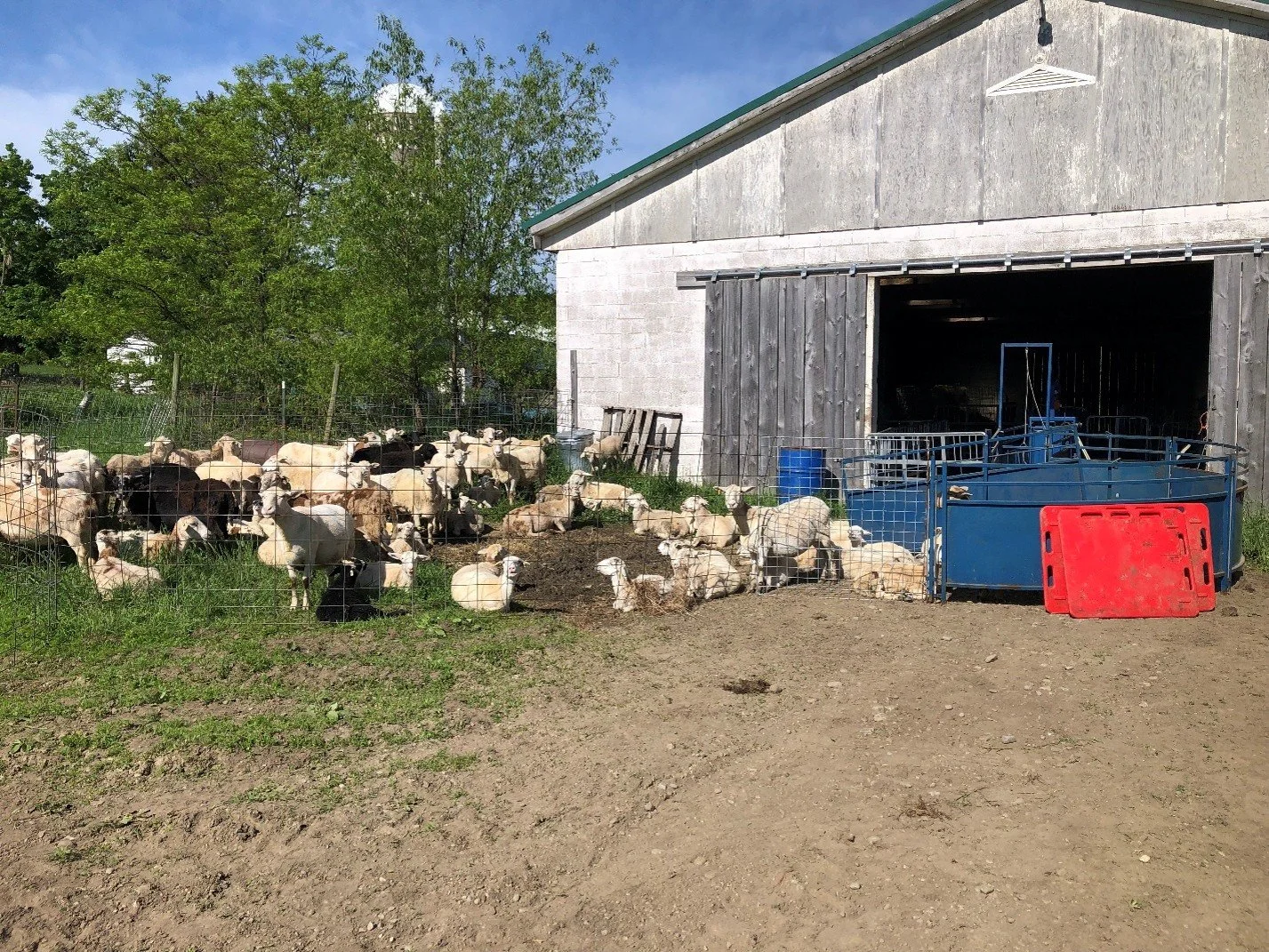
Photo description: This restraint system features a simple catch pen made from hog panels with a crowding pen at one side. The crowding pen moves animals into the short raceway and ends with a weigh crate. Photo credit: Amy Barkley