Cost-Benefit Considerations of Rotational Grazing as Part of an IPM Strategy for Sheep and Goats
By Amy Barkley, Livestock Specialist, CCE SWNYDLFC Team
Rotationally grazing sheep and goats has clearly documented benefits. Improved forage availability, better nutrition management, improved immune health, and management of parasites by removing animals from their infected feces and problem pastures during high risk periods are all ways that this system works for the producer. On the other hand, continuous pasture systems with limited acreage result in severe parasite challenges for our small ruminants. It's not uncommon to hear of losses of 10%–25% in herds and flocks that are not systematically rotating animals on pasture.
From a forage perspective, pastures should be rotated when the average forage height is grazed down to 4 inches. Once the forage regrows to about 8–10 inches, animals can be let back on to graze. This grazing height recommendation not only keeps plants from being set back too far before their rest period but also lines up with recommendations for parasite control — most small ruminant internal parasites reside only in the lower 2 inches of forage because of their sensitivity to drying out.
The other thing to remember is that in the spring and fall, forages in primarily cool season pastures need about 3 weeks to regrow. In the summer, the heat and relative lack of moisture extend that regrowth period to 45 days. When thinking about forage availability alone, these rules are generally sufficient when considering re-grazing schedules. However, for parasite control, they are not. The American Consortium for Small Ruminant Parasite Control recommends a practical rest period of 45–60 days for pastures following the movement of small ruminants, with 60-105 days being the gold standard.
Figure 1 shows the survival of barber pole worm larvae on pasture (for reference, 20°C is equivalent to 68°F). This chart indicates that waiting 45 days produces a 55%–90% reduction in infective larvae without a host present, depending on temperature, while waiting 60 days gives a 60%–95% reduction. Waiting the full 105 days gives a reduction of 70% - 100%. Cooler temperatures allow the parasites to persist longer than warmer temperatures do, which means the fallow period should be longer during cooler weather. This illustrates that pasture management for internal parasite control often conflicts with what's recommended for pasture rotation from the plant's perspective alone. This can be frustrating for small ruminant producers, since it can mean pasture gets ahead of them. To combat this, some producers opt to hay a portion of their land in the spring and graze it following that first cutting to capture as much forage as possible while staying ahead of plant maturity. Others may clip the pastures to discourage weedy plants from seeding and encouraging regrowth of desirable species.
Figure 1: Survival of barber pole worm infective larvae on pasture at various daily maximum temperatures and 60% relative humidity.
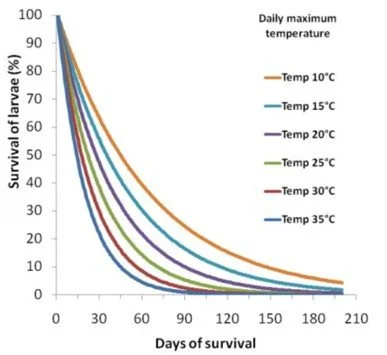
Source: Wormboss.com/au. Modeled from death rate of L3 population in ‘Simulation of pasture larval populations of Haemonchus contortus’ by IA Barger, PR Benyon, and WH Southcott. Proceedings of the Australian Society of Animal Production (1982) 9:30.
Designing the System: What Does It Cost?
Given the challenges small ruminant grazing systems face, it's worth taking a moment to consider the cost of designing and implementing a pasture system flexible enough to allow both frequent movements and long rest periods. To do this, let's design a grazing system around a group of 25 mature animals, which is a typically sized herd or flock in southwestern New York.
There are several ways to develop a grazing system, and each one depends heavily on the number and weight of animals, lambing/kidding timing, forage type and availability, and anticipated grazing days in a calendar year. We won't dive that deep into grazing plan development in this article; instead, we'll focus on estimating the cost of installing a rotational pasture system.
In a setting where pastures are actively managed, rotated, and consistently produce high-quality forage, the rule of thumb is that you can stock 5 animals per acre. This applies to mature animals or dams with youngstock by side. Once youngstock start grazing on their own, they'll need their own acreage. This is an ideal scenario, so doubling that acreage requirement for this example allows for some flexibility to give them more pasture if needed.
Perimeter Fencing: If you have sheep or goats, you likely already have perimeter fencing in place. But if you're installing new fence, woven wire runs $2.33–$4.23/linear foot, while 5–6 strand high tensile runs $1.92–$2.85/linear foot. These figures were calculated from various extension articles pricing farm fence installations from 2024–2026. For 25 animals on 10 acres laid out as a perfect square, that equates to 2,640 feet of perimeter fence. When penciled out, 10 acres of perimeter fencing costs between $5,068 and $11,167.
Interior/paddock fencing: You can subdivide a grazing area into paddocks with permanent fencing, but this is expensive and far less flexible than temporary fencing. Sheep and goats don't respect a single-strand electric divider the way cattle do, so electric netting with a minimum height of 35" is preferred for these species. This fencing costs about $150–$175 per 164-foot roll. A square quarter-acre paddock requires 418 linear feet, or 3 rolls of fencing.
Energizers: Fence energizers are an additional cost, ranging from $200–$400. Plug-in energizers sit at the lower end of that range compared to solar chargers, which are generally more expensive. Solar energizers are typically used for stand-alone interior fence squares, while plug-in energizers are used to electrify high-tensile perimeter fence, which you can use to provide power to the interior fences. An energizer of at least 2 joules is necessary to run electric net fence, since it carries higher impedance than high-tensile fence due to its net structure and regular contact with weeds and grasses.
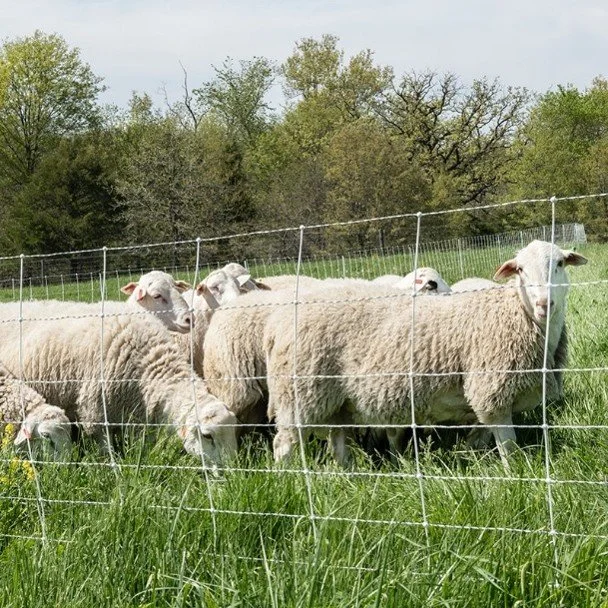
Figure 2: Electric net fencing is a popular choice for sub-dividing sheep and goat pastures to successfully keep the animals in and predators out. Image from Premier1Supplies.
Watering systems: These are crucial for grazing success, and their design and cost depend heavily on how often you move animals and how many you have. A sheep or goat drinks 1–3 gallons of water daily, depending on weather and forage moisture. When budgeting costs, account for either the time it takes to haul water out to animals if using a portable system or the cost of installing a more permanent watering system.
Mineral Feeders: If offering minerals in the pasture, covered mineral feeders are recommended if you're feeding loose minerals. This keeps them protected from the elements. A feeder like this runs about $250–$300. Mineral blocks are generally left out in the elements but would also benefit from a covered feeder.
Labor: Beyond fencing, watering systems, and mineral feeders, a major cost of a rotational grazing system is labor. There's a real tradeoff here between upfront capital cost and ongoing labor. Permanent, pre-subdivided pastures don't require regularly moving temporary fence, but they cost more to install and offer less flexibility in paddock size. Moving animals from one permanent paddock to another takes about 15 minutes. From experience working with farmers, in a system using temporary fencing, moving three sections of temporary fence plus the animals takes about an hour to an hour and a half.
For a quarter-acre paddock with 4" of moderate-density cool season forage, the NRCS grazing stick indicates enough forage to support 25 animals for about 5 days. In spring and fall, that may stretch to 7 days. To manage parasites effectively, moving animals at least once weekly helps reduce their consumption of infective larvae. The gold standard is moving animals every 1–3 days, since barber pole worm and brown stomach worm eggs can hatch and become infective in as little as 3 days under ideal conditions.
If you are bringing animals back to the barn at night for feeding and protection, this adds time to your day. For many farms, this extra movement takes an additional 30–45 minutes of care daily.
Where's the Return on Investment?
With all of these costs outlined, you may be thinking, "Why would I invest that much money in a rotational grazing system, and what's my return?" Beyond the reduced labor of cleaning out the barn and feeding animals indoors, properly managed rotationally grazed pastures provide excellent nutrition that improves immune function to help animals fight off parasite burdens, resulting in improved weight gain, healthier pregnancies, and better weaning weights.
Where the rubber meets the road on ROI is reduced mortality from heavy worm burdens, particularly barber pole worm, which can kill lambs within 5 days of reaching a critical population in the body. You'll still need to regularly FAMACHA score animals and deworm as needed, but reducing overall parasite loads means fewer animals become critically ill faster than you can identify and treat them. Values for sheep and goats range from $150–$400 per animal for commercial sales, and up to $500–$1,000 for high-end breeding or show stock. Losing one or two animals is something most operations can absorb and is expected even under even the best conditions. Losing multiple animals is not and can be the deciding factor between profit and loss for the year.
So, while managing a rotational grazing system is more financially and labor intensive than continuous grazing, it typically pays for itself. What you may notice this article doesn’t share is the exact cost-benefit analysis for your operation, and that’s by design! Each system is going to be different, and using the numbers and considerations shared above can give you an idea of what it may cost to implement a rotational grazing system. If you're thinking about designing a system like this and want personalized assistance, reach out to your local Extension office or regional team; we’re here to help!
This work is supported by the Northeast Extension Risk Management project award no. 2024-70027-42540, from the U.S. Department of Agriculture's National Institute of Food and Agriculture.
Resources:
1.) American Consortium for Small Ruminant Parasite Control. https://www.wormx.info/
2.) Bilderback, D. (2024). University of Tennessee. Fencing Budget Calculator: https://arec.tennessee.edu/fencing-budgets-calculator/
3.) Drollette, R. (2024) Iowa State University. Ag Decision Maker: Estimated Costs of Livestock Fencing. https://www.extension.iastate.edu/agdm/livestock/html/b1-75.html
4.) Kientzt, D. and Milhollin, R. (2026) University of Missouri Extension. Pasture Fence Construction Budget. https://extension.missouri.edu/publications/g1193
5.) Wormboss.com (2022). Larval Survival of Barber’s Pole Worm. https://wormboss.com.au/tests-tools/grazing-management-sheep/larval-survival-of-barbers-pole-worm/